Odinism - Witch of the North
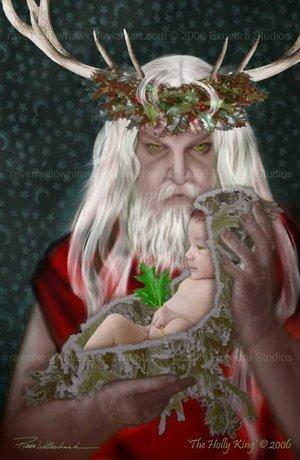
THE HOLLY KING
From the Celtic tradition, we get a pair of ancient pagan images who fight for supremacy at Yule. The Holly King and the Oak King are probably constructs of the Druids to whom these two trees were highly sacred.
The Oak King (king of the waxing year) kills the Holly King (king of the waning year) at Yule. The Oak King then reigns until Midsummer when the two battle again, this time with the Holly King as the victor.
The Holly King, who has evolved into the present day Santa Claus, wears red, dons a sprig of holly in his hat, and drives a team of eight (total number of solar sabbats) deer, an animal sacred to the Celtic Gods.
Holly and mistletoe are traditional to the season through commemoration of the battle.
The holly was hung in honor of the Holly King; the mistletoe (which grows high in the branches of oak trees) in honor of the Oak King.
The Oak King and Holly King are mortal enemies at Midsummer and Yule, but they are two sides of a whole, and neither could exist without the
other.
SANTA CLAUS
Today's Santa is a folk figure with multicultural roots. He embodies characteristics of Saturn (Roman agricultural god), Cronos (Greek god, also known as Father Time),
the Holly King (Celtic god of the dying year), Father Ice/Grandfather Frost (Russian winter god), Odin/Wotan (Scandinavian/Teutonic All-Father who rides the sky on an eight-legged horse), Frey (Norse fertility god), the Tomte (a Norse Land Spirit known for giving gifts to children at this time of year), and Thor (Norse sky god who rides the sky in a chariot drawn by goats).
Julbock or Julbukk, the Yule goat, from Sweden and Norway, had his beginnings as carrier for the god Thor.
Now he carries the Yule elf when he makes his rounds to deliver presents and receive his offering of porridge.
When Early Christians co-opted the Yule holiday, they replaced the ancient Holly King with religious figures like St. Nicholas, who was said to live in Myra (Turkey) in about 300 A.D.
Born an only child of a wealthy family, he was orphaned at an early age when both parents died of the plague. He grew up in a monastery and at the age of 17 became one of the youngest priests ever. Many stories are told of his generosity as he gave his wealth away in the form of gifts to those in need, especially children. Legends tell of him either dropping bags of gold down chimneys or throwing the bags through the windows where they landed in the stockings hung from the fireplace to dry. Some years later Nicholas became a bishop--hence the bishop's hat or miter, long flowing gown, white beard and red cape.
When the Reformation took place, the new Protestants no longer desired St. Nicholas as their gift-giver as he was too closely tied to the Catholic Church. Therefore, each country or region developed their own gift-giver. In France he was known as Pare Noel. In England he was Father Christmas (always depicted with sprigs of holly, ivy, or mistletoe). Germany knew him as Weihnachtsmann (Christmas man). When the communists took over in Russia and outlawed Christianity, the Russians began to call him Grandfather Frost, who wore blue instead of the traditional red. To the Dutch, he was Sinterklaas (which eventually was mispronounced in America and became Santa Claus).
La Befana, a kindly witch, rides a broomstick down the chimney to deliver toys into the stockings of Italian children.
These Santas were arrayed in every color of the rainbow--sometimes even in black. But they all had long white beards and carried gifts for the
children.
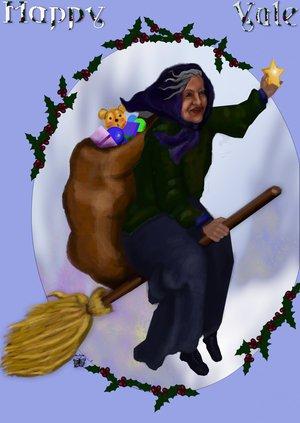
La Befena Lore
La Befana is one of Italy's oldest and most celebrated legends. Each year on January 6 the children of Italy awaken in hopes that La Befana has made a visit to their house. This is a significant day to Italians because it marks the end of the Christmas season and the day that the three Wise Men arrived at the manger of the Christ child. Over the years the Epiphany has been a more celebrated holiday for the children of Italy than even Christmas.
As legend has it the three Wise Men were in search of the Christ child when they decided to stop at a small house to ask for directions. Upon knocking, an old woman holding a broom opened the door slightly to see who was there. Standing at her doorstep were three colorfully dressed men who were in need of directions to find the Christ child. The old woman was unaware of who these three men were looking for and could not point them in the right direction. Prior to the three men leaving they kindly asked the old woman to join them on their journey. She declined because she had much housework to do. After they left she felt as though she had made a mistake and decided to go and catch up with the kind men. After many hours of searching she could not find them. Thinking of the opportunity she had missed the old woman stopped every child to give them a small treat in hopes that one was the Christ child. Each year on the eve of the Epiphany she sets out looking for the baby Jesus. She stops at each child's house to leave those who were good treats in their stockings and those who were bad a lump of coal. This is similar to the Puerto Rican Three Kings Day/Epiphany Holiday on January 6th.
All of these Santas, however, never stray far from his earliest beginnings as god of the waning year. As witches, we reclaim Santa's Pagan
heritage.
REINDEER
Santa's reindeer most probably evolved from Herne, the Celtic Horned God. Eight reindeer pull Santa's sleigh, representative of the eight solar sabbats. In British lore, the stag is one of the five oldest and wisest animals in the world, embodying dignity, power and integrity. From their late Autumn dramatic rutting displays, stags represented strength, sexuality and fertility. As evidenced by multiple prehistoric excavations of stag antler ritual costumes, the wearing of stag antlers in folk dance recreated the sacred male shaman figure called Lord of the Wild Hunt, Cernunnos, or Herne the Hunter, among others--he who travels between worlds, escorting animal spirits to the afterlife and sparking wisdom and fertility in this world. Likewise, the stag's branching antlers echo the growth of vegetation. In America, the stag represents male ideals: the ability to "walk one's talk," and powerfully, peacefully blend stewardship and care of the tribe with sexual and spiritual integrity.
In Northern European myth, the Mother Goddess lives in a cave, gives birth to the sun child, and can shape shift into a white hind, or doe. Therefore, the white hind was magical, to be protected and never hunted. In myth, graceful running women of the forest--who were actually magical white hinds--brought instant old age or death to hunters who chased them.
To the Celts, all deer were especially symbolic of nurturing, gentle and loving femaleness. White deer hide was used to make tribal women's clothing. White deer called "faery cattle" were commonly believed to offer milk to fairies. In Britain amongst the Druids, some men experienced life-transforming epiphanies from spiritual visions or visitations by white hinds, balancing and healing their inner feminine energy. In Europe white hinds truly exist, and are many shades of warm white cream-colors, with pale lashes--otherworldly in their peaceful and modest behavior. To many Native American tribes, deer are models of the graceful and patient mother who exhibits unconditional love and healthy, integrated female
energy.
Poinsettias
Poinsettias are native to Mexico. They were named after America's first ambassador to Mexico, Joel Poinsett. He brought the plants to America in 1828. The Mexicans in the eighteenth century thought the plants were symbolic of the Star of Bethlehem. Thus the Poinsettia became associated with the Christmas season. The actual flower of the poinsettia is small and yellow. But surrounding the flower are large, bright red leaves, often mistaken for
petals.
Xmas
WREATHS
The Wheel of the Year is often symbolized by the wreath. Its circle has no beginning and no end, illustrating that everything in its time comes back to its point of origin and travels onward, over and over again. Scandinavians began the tradition of hanging the wreath at Yule, the beginning of their new year, to commemorate new beginnings in the cycle of life. Today in rural Germany, a giant wreath, known as St. Catherine's Wheel, is a holdover from another pagan custom which involved sympathetic magick to lure the sun's warmth back to the earth. A giant four-spoked wheel with an effigy of a person bound to it, is lighted on fire and rolled down a hill. (The effigy probably hearkens back to a time when human sacrifices were made in plea to the sun.) In some traditions, Yule was a more important holiday for honoring the Sun God than Midsummer. In Winter, Mother Earth was cold and barren without the fertilizing power of Father Sun.
The Egyptians were part of a long line of cultures that treasured and worshipped evergreens. When the winter solstice arrive, they brought green date palm leaves into their homes to symbolize life's triumph over death.